Civil court figures show progress, but injured people still face a year-long wait for justice
RELEASE: IMMEDIATELY
DATE: 4 September 2026
Civil court figures show progress, but injured people still face a year-long wait for justice
The Consumer Legal Association (CLA) has said further improvement is needed after new figures showed that injured people whose cases reach trial still face a median wait of more than a year, despite progress compared with the same period last year.
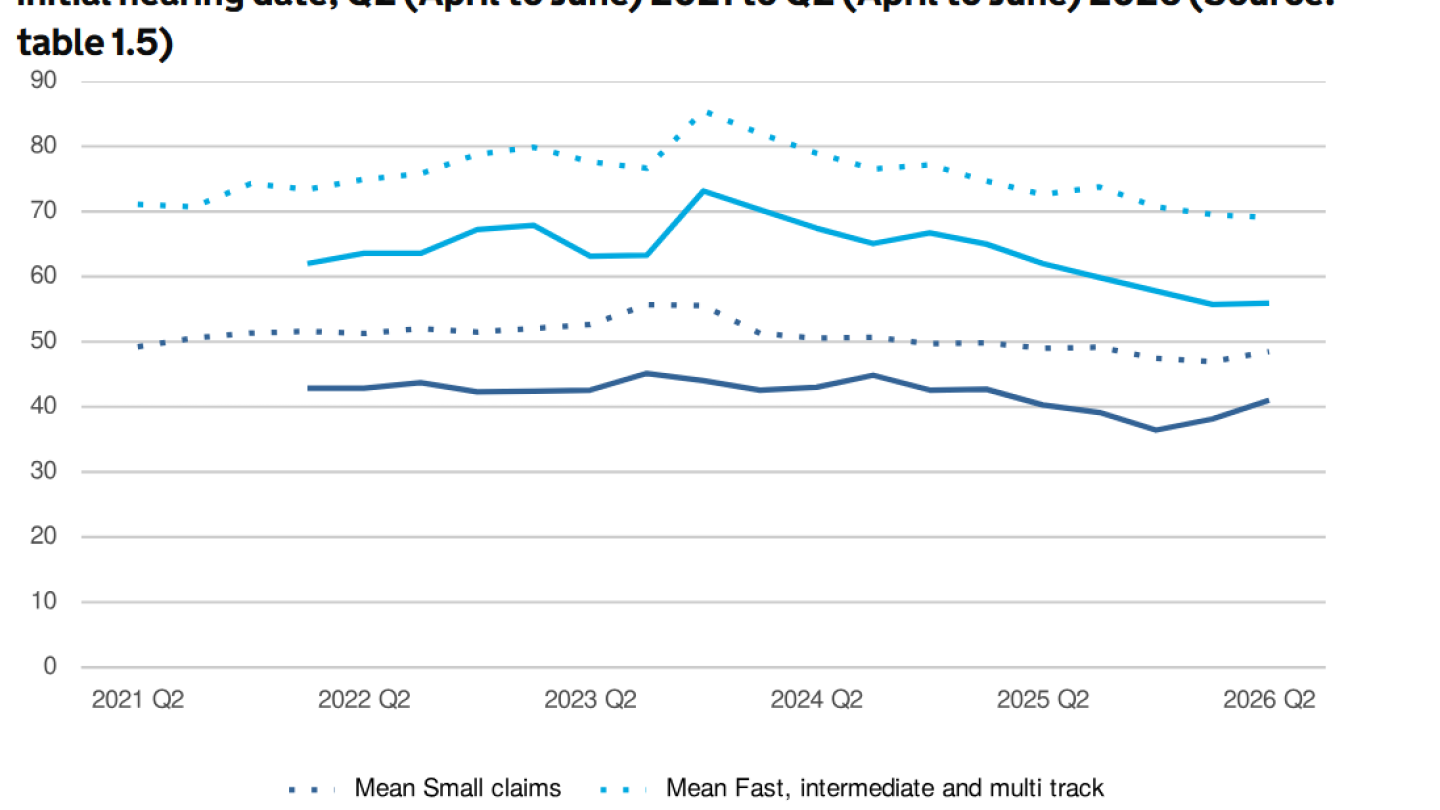
The Civil Justice Statistics Quarterly for April to June 2026, which were released yesterday, show that the median time taken for fast, intermediate, and multi-track claims to reach trial was 55.9 weeks. This was 6.1 weeks shorter than in April to June 2025, but still more than a year. The median wait for small claims was 41.0 weeks, 0.7 weeks longer than a year earlier. Compared with the revised previous quarter, the median waits increased by 0.2 weeks and 2.9 weeks respectively. The quarter-on-quarter deterioration should be interpreted cautiously. The publication does not provide a seasonally adjusted series, Q1-to-Q2 movements have varied in previous years, and the figures for the latest quarter are provisional.
David Whitmore, Chair of the CLA, said: "The year-on-year figures show welcome progress for fast, intermediate and multi-track claims. However, the quarter-on-quarter deterioration gives some cause for concern and should be watched closely. A single quarter can fluctuate, so it is too early to say that the longer-term trend has reversed. A median wait of 55.9 weeks still means people whose cases reach trial are waiting more than a year for justice, while small-claims waits have risen slightly compared with last year. For injured people, delay can hold up compensation, rehabilitation, treatment and adaptations. Further improvement is needed."
The CLA also cautioned against relying too heavily on median waiting times, which do not fully reflect the experience of court users facing the longest delays. On the mean measure, waiting times remain substantially above pre-pandemic levels. Average waits for fast, intermediate and multi-track claims stand at 69.1 weeks, compared with 59.0 weeks in April to June 2019, while small claims take an average of 48.5 weeks compared with 36.6 weeks before the pandemic.
The headline 55.9-week figure also captures only the period between a claim being issued and reaching trial, and only for cases that actually proceed to trial. For many injured people, the path to justice begins long before court proceedings are started and can involve months or years without access to compensation, rehabilitation or other support.
The statistics show that 26,000 damages claims were issued during the quarter, down 4% on the same period in 2025. This included 11,000 personal injury claims and 15,000 other damages claims, both also down 4%.
The Ministry of Justice notes that the volume of personal injury claims has trended down since late 2022, while warning that classification issues limit comparisons across parts of the series. It also identifies the whiplash reforms as one factor behind fewer road traffic accident claims going through the courts.
Whitmore said: "A decline in claim volumes is not the same thing as improved public safety or reduced need. Injured people usually have only three years from the injury, or from when they became aware of it, to bring a claim. If people are deterred by complexity, unable to obtain advice or simply unaware of their rights, they risk losing access to justice altogether. The focus should be on whether injured people can secure fair redress, not simply on whether fewer claims appear in the statistics."
The figures also show defended claims rising by 15% to 82,000, while the number of trials fell by 10% to 12,000. However, the statistics do not identify where delays occur within the process. The CLA is therefore calling for better information on adjournments, missed deadlines and extensions, alongside firmer case management and greater accountability across the civil justice system.
Whitmore concluded: "The aim must be to identify issues early, make admissions promptly and resolve claims at the earliest fair opportunity. Claimant firms, defendants, experts and the courts all have a part to play. Faster justice requires accountability across the process."
The CLA remains committed to advocating for a civil justice system that delivers timely redress and meaningful access to justice for injured people.
ENDS
Media contact
Cayla Murray-Ridgway
Public Affairs and Policy Adviser
Consumer Legal Association
cmurrayridgway@consumerlegal.org.uk
+44 7304 490186